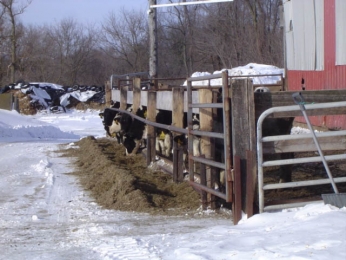
CHENANGO COUNTY – New York Regional Interconnect refers to the path along the Marcy railroad track as a no-man’s land, but a closer look reveals that vast expanses of land are actually home to not only thousands of families and farms, but to thousands of cows that produce millions-of-dollars worth of milk and meat products for New York City.
“There’s ‘nothing’ there,” is a sentiment we’ve heard echoed repeatedly from New York Regional Interconnect executives as justification for running a mega 400-kilovolt DC power line through the bucolic towns and farms of Central New York. Its purpose would be to deliver additional energy to the people of New York City.
Ironically, those very same urban dwellers rely on farms along <a href="http://www.evesun.com/topics/news/NYRI/">NYRI</a>’s proposed path of “nothings” for their liquid milk and milk-related products (i.e., butter, cheese), as well as for beef and pork.
Central New York is one of the last agricultural regions in the state, and is a large producer of New York’s leading agricultural product: milk. In fact, milk accounts for one-half of New York’s total agricultural receipts. Production in 2005 was 11.7 billion pounds with a preliminary value of $1.91 billion. Add to that fact that the livestock production from the region has increased, and it’s easy to see how New York marketed 246 million pounds of meat during 2005, bringing in $190 million in cash receipts. Sales from cattle and calves accounted for $173 million, hogs and pigs returned $13.0 million, and sheep and lambs provided $3.67 million.
A Closer Look:
If hovering overhead in a corporate helicopter or jet, <a href="http://www.evesun.com/topics/news/NYRI/">NYRI</a> executives and New York politicians might easily misconstrue open spaces and little “dots” below as “nothing,” so let us engage in a virtual landing amid these rolling hills so we can all see just who the “nothings” are and what they do for the state of New York:
The first is Indian Camp Farm — one of the farms in the path of the <a href="http://www.evesun.com/topics/news/NYRI/">NYRI</a> power line.
David S. Kross, 66, his son, Andrew, 34, and four employees produce approximately 2,300 gallons per day of milk for delivery to New York City. They do so currently within the embrace of hundreds of acres sitting beneath pristine skies and alongside a meandering Chenango River, a tributary of the Susquehanna River that stretches along 90 miles.
Hemmed in by the river, the farm’s site was once home to Native Americans, who originally settled there because of the fertile soil and natural water and fish supplies. David and his family were drawn to the lowlands of the Central New York landscape for the same reason. “We knew this region was geologically recent, which means the soil is ideal for growing corn and hay — essential to a dairy farm,” David says.
“When we first moved here, hundreds of arrowheads and Indian pottery artifacts were discovered when we plowed our corn fields. Local archeologists and neighbors would come from all over to see if they could find arrowheads in the upturned soil,” adds David.
While its soil and location drew David and wife Carole, 65, to the farm in 1969 from nearby Smithville Flats, the ensuing lifestyle has kept them there.
“When you work within the cycle of life, and you see your kids and grand-kids out the window feeding a calf, loading the hay mow, or helping with the birth – or even death – of an animal, you see a family with a much greater capacity to cope with life,” says Carole.
David’s daughter. Leanne, 40, agrees. As a nursery school teacher in the nearby Hamilton community, she is grateful her six-year-old son can grow up fishing in the river and working in the fields the same way she and her siblings did.
“Rather than having nothing to do but play video games or being stuck in front of a TV, he has an opportunity to really embrace the natural world,” says Leanne.
She says the sentiment is shared by her sister, Brenda, 38, who works for PEACE Inc., a Syracuse-based social services organization that helps people in local communities.
For Leanne’s 34-year-old brother, Andrew, the farm is a life force that called him back from Ithaca. Andrew went to Cornell to become a Dairy Fellow, and has since returned to help his father manage the 610 milking-age and replacement cattle.
Through the evolution of the farm, Andrew and his father have had to accommodate many changes in legislation, economics and science.
“Operating a farm is more than just knowing your animals; you have to understand the futures market, supply-and-demand economics principles, the technological innovations in the industry, and a lot more,” David says.
He notes, for instance, that feeding and management of the cows has been changing with the drive toward ethanol as fuel.











